Exhibition guide
After his spectacular success at the Venice Biennale in 2024, the painter Alioune Diagne returns to Paris with “Saytu”, a set of new paintings, the result of an investigation carried out over the last two years across Senegal.
Visit details
- Dates: From Thursday May 21, 2026 to Saturday July 18, 2026: Tuesday, Wednesday, Thursday, Friday, Saturday from 10:00 a.m. to 7:00 p.m.
- Venue: Galerie Templon / Paris - Grenier Saint Lazare, 28, rue du Grenier-Saint-Lazare, Paris
- Price: free
- Audience: All audiences
- Source: Event page
About the exhibition
In Wolof the term saytu refers to the idea of searching, of inspecting, in order to find and preserve what is precious. With this in mind, the artist traveled for several months through the center and south-east of the country, meeting minority communities living in isolated regions - the Bassari, Bédik, Dialonké and Coniagui - whose ancestral customs and rituals he documented that they perpetuate and try to preserve.
The project began with a two-month stay in Bassari country, in the village of Etiolo, then with the Bédik, in the localities of Ethiwar, Ibel, Iwol and Andjel, where Alioune Diagne visited twice. Diagne also shared the daily life of the Dialonkés, in Madina Baffé and went to the center of Senegal to the Coniaguis, in Koupentoum, today unfortunately marked by the progressive disappearance of certain rituals.
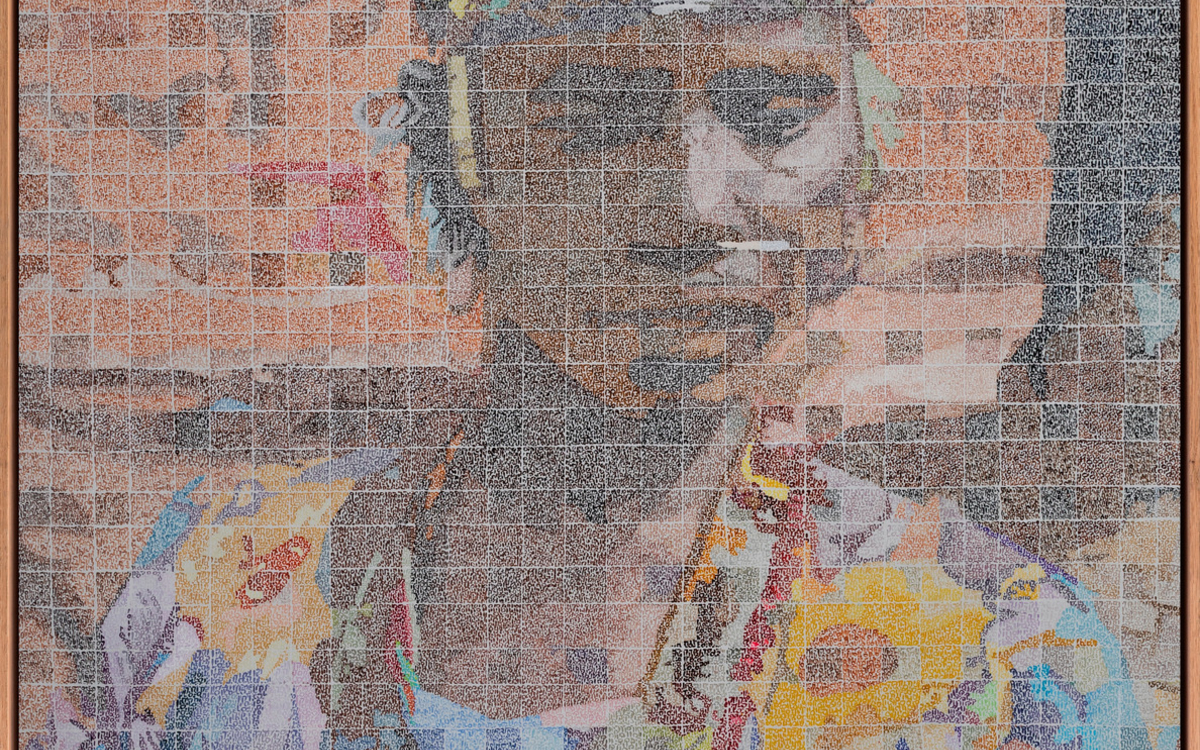
Close to these communities, the artist patiently observed, documented then reinterpreted these traditions through his unique plastic language. His technique, gradually developed over the years, is based on the assembly of small modules that he calls “unconscious signs”: aggregated together, they compose figurative scenes of great intensity. Masks, dances, costumes, music and songs are thus transposed into painting, in an attempt to capture the vibrant energy and spiritual essence of these ceremonies.
Influenced, without first being fully aware of it, by the know-how of his grandfather, a Koranic master, Diagne conceives this formal, almost pointillist vocabulary, as a universal language capable of communicating the inexpressible. Between abstraction and figuration, certain paintings like Young Bassari Girl (2025), are immediately visible, while others like The Dancing Crowd or Under the Sacred Tree (2025), invite the viewer to a slow decipherment, preserving the element of mystery specific to these traditions transmitted orally from generation to generation.
Chronicler of his time, the artist aims to constitute, in his own way, the future archives of Senegal. Faces/Time, a monumental installation bringing together 100 portraits of individuals encountered throughout his journey, is also an illustration of this. These anonymous faces, bearers of stories and individual memories, refer to the intimacy of each existence while recalling the evanescent identities of our digital profiles. “Saytu” is then part of a broader reflection on the transmission of knowledge in the era of social networks and globalization. How are these cultural heritages evolving today? What place will they occupy tomorrow?
Among the communities met, Diagne also paid particular attention to women and their specific rituals, highlighting their central role in social life and the transmission of knowledge. The