Exhibition guide
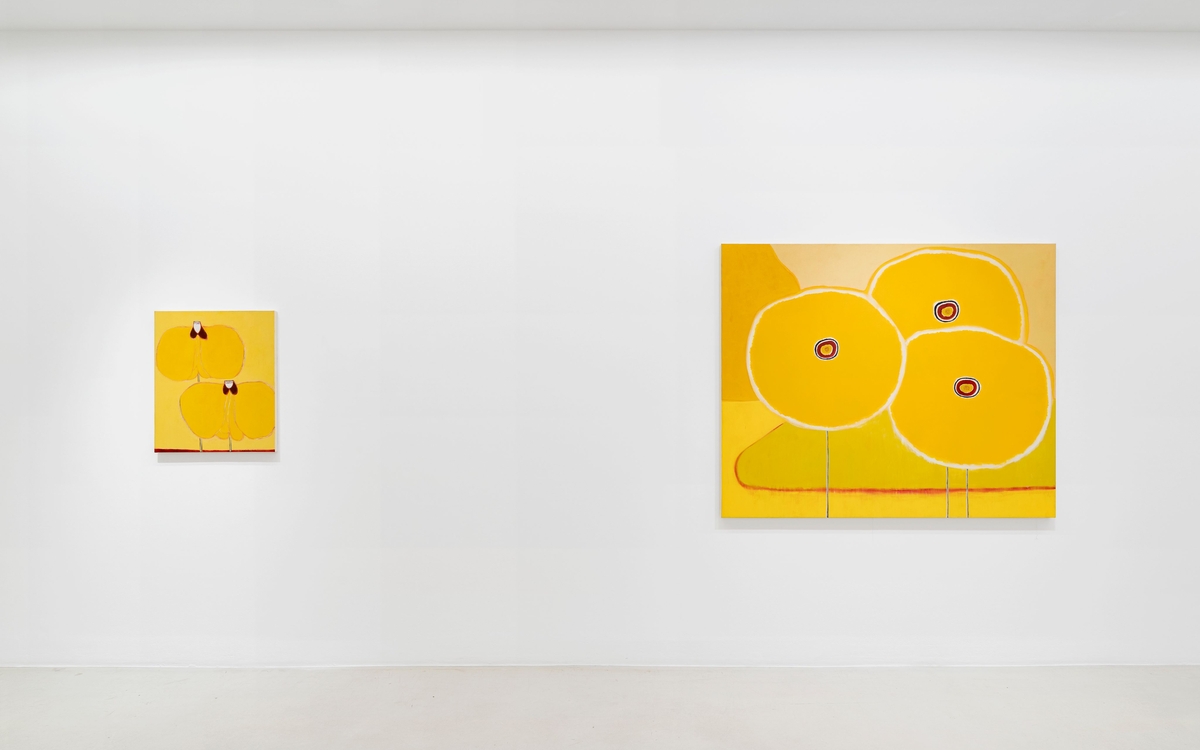
The Perrotin gallery is pleased to present Susumu Kamijo's second exhibition in Paris, after The Sun Inside, presented in 2023. This new presentation immerses us in a calm and poetic universe, populated by monumental flowers, animals and landscapes with intuitive lines.
Visit details
- Dates: From Saturday April 25, 2026 to Saturday May 30, 2026: Tuesday, Wednesday, Thursday, Friday, Saturday from 10:00 a.m. to 6:00 p.m.
- Venue: Galerie Perrotin - Marais, 76, rue de Turenne, Paris
- Price: free
- Audience: All audiences
- Source: Event page
About the exhibition
The painted world of Susumu Kamijo is populated by large flowers, fruits, sometimes animals, butterflies, parakeets, sailfish, and some mundane objects. Occasionally, we come across a human figure. It's a calm world. We can see, in the background, an element that reminds us of the scale of the scene, like a cloud floating in the sky, a horizon line on the sea, a colorful hill. But here is a painting which never tries to produce the illusion of depth or to tell a story.
If we take the distinction that the art historian Leo Steinberg formulated in 1968 based on the work of Robert Rauschenberg, with the model of painting as a vertical window on one side, and on the other, that of painting as a horizontal screen-platform (flatbed picture plan), it is clear that the work of Susumu Kamijo falls into the second category. The presence of signs of the landscape obeys an intuitive logic, which has exclusively to do with the exploration of the flatness of the pictorial surface. “If I feel like something is needed there, then I add a cloud, and that helps maintain a balance in the composition,” explains the artist. Chromatic choices involve a similar process, with certain colors and certain color combinations irresistibly attractive, for reasons having to do with the requirements of organization of the painted surface, visual and emotional effects, and not representation. As for these large flowers – recurring in his paintings – they play above all the role of formal agents. The artist describes the dynamics contained by their forms as a principle of expansion of a central area which opens up. The flower is an interesting motif to paint, in short, because it is capable of creating its own space. “Like a big bang, a nebula” he specifies.
In certain respects, Susumu Kamijo therefore paints like an abstract, a fact already noted when he became known in 2016-2017 for his series of paintings on paper representing poodles, series whose principle, based on the play of repetition and variation of the motif, proved conducive to the development of a formalist approach. Kamijo was born in Japan in 1975, but has lived in the United States since he was sixteen. And he discovered quite early the tradition of abstract expressionism, which he continues to cite, with the work of Milton Avery (one of the masters of Mark Rothko and Barnett Newman) as a crucial reference for his work. His first paintings, produced while he was an art student at the University of Oregon, were also abstract.
But of course, this approach through form alone is not enough to exhaust either the effect or the meaning of his work. Firstly because the sense of composition that he displays in his paintings echoes, by his own admission, a biographical experience. “I grew up in the countryside, in